Three months ago we told you SpaceX was on sale. On October 20, after the close, the company handed in its first profitable quarter as a public company, and the next morning eight Wall Street firms raised their price targets — one of them to $500. The stock closed October 21 at $159.31, up 7.8%.
Here is where our call stands, what the quarter actually said, and why Tesla now belongs in the same conversation.
SpaceX (NASDAQ: SPCX) — the scorecard
NASDAQ: SPCX
Our July alert
~$111
July 24, below the $135 IPO
High since
$176.42
October 6 · +59%
Today’s close
$159.31
Oct 21 · +43% from our alert
Street-high target
$500
JPMorgan, raised Oct 21
A quick recap for anyone who joined us recently:
We first wrote up SpaceX in June, right after the largest IPO in history, at ~$155 — a hold-for-years position, buy in pieces, let the lock-up volatility come to you. In late July, with the stock knocked down to ~$111–113, below its own IPO price, we put out an urgent buy alert: Wall Street had just initiated coverage with a consensus target near $244, a third of the float was sold short, and the shorts were fighting Elon Musk. We said accumulate.
Since then the stock did exactly what a thinly-floated mega-IPO does. It bottomed at $108.27 on August 5, the day after its first earnings report, as the lock-up supply hit. Then it climbed — through the Nasdaq-100 inclusion, through Starship’s first-ever orbital flight, through tranche after tranche of insider unlocks that the bears promised would bury it.
In the first week of October, word of large AI-compute contracts with Google and Anthropic sent it up roughly 20% in three sessions to a high of $176.42 on October 6. It then gave back about 16% into the earnings report as the whole AI-infrastructure group sold off, closing at $147.79 on October 20. Anyone who followed the July advice to keep dry powder got a second bite at the apple.
What the quarter actually said
The third-quarter report, released after the close on October 20, was not a modest beat. It was a different company than the one the skeptics described in June:
Revenue of $14.58 billion, up 161% from a year ago, against a Street estimate of about $12.7 billion. Earnings of $0.35 a share versus $0.15 expected. Adjusted EBITDA of $8.8 billion versus $6.6 billion expected. Every segment beat.
Starlink did $5.2 billion in revenue, up 69%, with 13.6 million subscribers across 174 markets — 1.6 million added in a single quarter — and the average subscriber paying more per month ($69, up from $66), not less. The one blemish the analysts found in the entire report was that subscriber adds came in a touch below the most aggressive forecasts. That is the kind of problem we like.
The AI business — the xAI unit the bears called “a cash drain bolted onto a rocket company” — produced roughly $7 billion in revenue, up from under $1 billion a year ago, and turned an operating profit. The CFO said new compute deployments are pricing “slightly above the high end” of the $30–50-per-watt range and pay for themselves in under a year. The company expects to exit 2026 with 2–3 gigawatts of compute and add as much as 10 more in 2027. Musk told analysts he sees annual recurring revenue of $500 billion to $1 trillion by the end of 2027. We would not bank on the top of that range — but even the bottom would make this one of the largest revenue bases on the planet, and the Street is still modeling well below it.
Capital spending, the number everyone feared, came in below expectations at $19.6 billion.
Wall Street’s response: eight target hikes in a morning
| Firm | Rating | Old target | New target |
|---|---|---|---|
| JPMorgan | Overweight | $240 | $500 |
| Cantor Fitzgerald | Overweight | $246 | $345 |
| Barclays | Overweight | $254 | $300 |
| Morgan Stanley | Overweight | $300 | $300 (reiterated) |
| Goldman Sachs | Buy | $230 | $245 |
| Citi | Buy | $200 | $240 |
| UBS | Buy | $210 | $230 |
| TD Cowen | Buy | $200 | $224 |
Evercore ISI and Wells Fargo raised their numbers as well. Of the 38 analysts who now cover the stock, 30 rate it Buy or Strong Buy.
Morgan Stanley’s note opened with a line we could have written ourselves: “Is it just me, or is the SpaceX story only just now starting to get interesting?”
A word about the headlines. If you only read the news feeds, you would think the quarter was a disappointment — a lot of the coverage led with the Starlink subscriber “miss” and the usual Musk theater, and some of it read as if it had been written before the numbers came out. We said in July that much of the financial press reflexively frames anything connected to Elon Musk in the most negative light available. Nothing has changed. Read the numbers, not the adjectives: revenue up 161%, a profit, capex below plan, and eight banks raising targets. The stock is now doing the talking.
What to watch now
The lock-ups are nearly behind us. Roughly 1.3 billion shares became sellable two days after earnings and another 329 million come free on October 24, with a final 857 million from the 180-day group after that; the standard 180-day expiration is December 8. Musk’s own ~6.4 billion shares stay locked until June 2027. This is the supply that was supposed to crush the stock. It has absorbed every tranche so far with the price rising. Once December 8 passes, the single biggest technical argument the bears have had is gone.
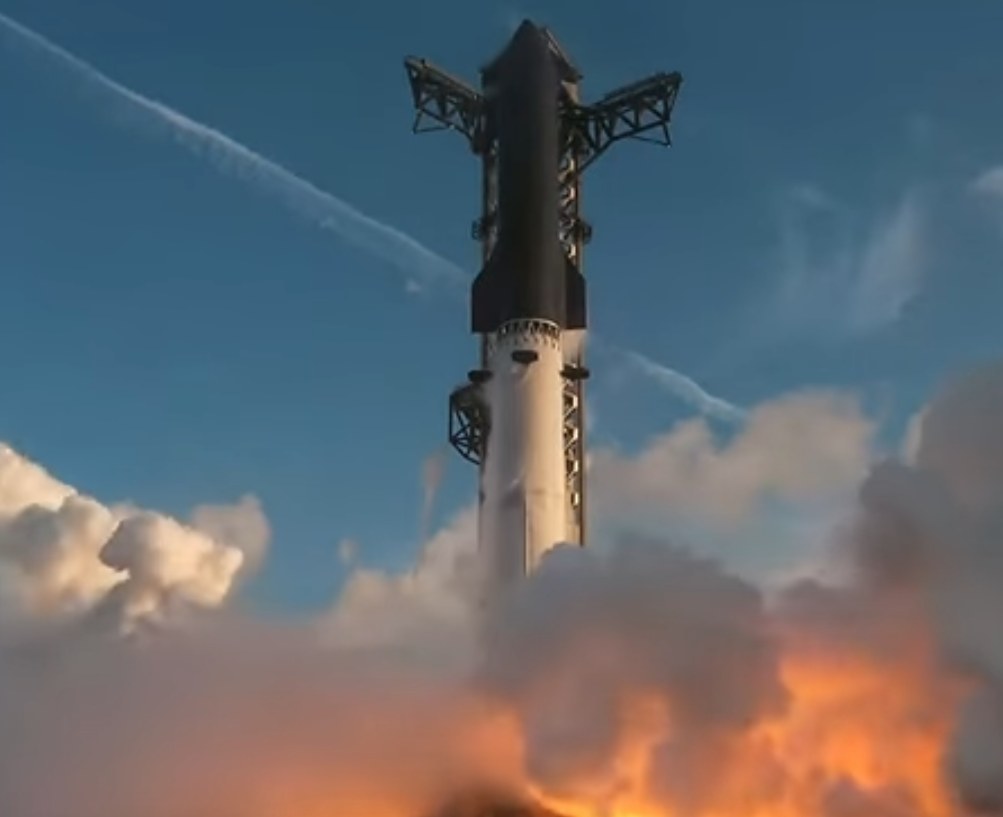
Starship works. On September 28, Flight 14 put Starship into orbit for the first time, released all 26 upgraded Starlink V3 satellites, and brought the ship back to a controlled splashdown three hours later. This is the proof point the whole next-generation Starlink and orbital-compute story depends on: a rocket this size, flying routinely, is what lets SpaceX put ten Falcon 9 launches’ worth of capacity into orbit at a time — and, eventually, the data centers we wrote about in June. Watch it from SpaceX’s own feed: the Flight 14 mission page → or the full webcast on YouTube →
Starship Flight 15 is next, and Musk says it will attempt to catch both the ship and the booster on return — something that has never been done. Citi calls it a “monumental space-industry catalyst.” Success is not guaranteed on these early attempts, and a failure would be a buying opportunity, not a reason to sell.
The S&P 500. SPCX joined the Nasdaq-100 on July 7. It is not yet in the S&P 500, because S&P requires GAAP profitability over the trailing four quarters. The October 20 profit starts that clock. When it qualifies, every S&P index fund in the world becomes a forced buyer.
Our view is unchanged: BUY / ACCUMULATE, hold for years. We are up 43% from the July alert and 59% at the October high, and the Street’s own targets — $240 at the low end, $500 at the top — still sit well above today’s price. Keep buying in pieces. This remains a volatile, headline-driven stock, and that volatility is the friend of the patient buyer.
Tesla (NASDAQ: TSLA) — the other half of the Musk empire just moved closer
NASDAQ: TSLA
In July we told you the bigger prize was one ticker for the whole Musk empire. That was talk then. On the October 20 SpaceX call, Musk confirmed that Tesla and SpaceX have each formed special committees of independent directors to evaluate a merger, at the request of shareholders.
Musk has recused himself as a conflicted party. He was careful to say a deal is not a certainty and that a Tesla vote would need a majority of all outstanding shares, “quite a high hurdle” — but he also said he sees “a lot of merit” in combining the AI software, the robotics, and the Terafab chip project under one roof. Ark Invest, which has followed Musk’s companies longer than almost anyone, put out an estimate that a combined SpaceX–Tesla could generate $3.8 trillion in sales and $2.7 trillion in operating profit by 2031.
Tesla reported its own third quarter on October 21, after the close, and it was better than the headlines. Revenue of $28.0 billion was in line; earnings of $0.48 a share beat the $0.45 estimate; operating margin came in at 2.6% versus 2.5% expected. The number that mattered most was free cash flow of +$1.5 billion — against a Street forecast of roughly negative $4.5 billion.
Deliveries of 486,532 beat by about 25,000. Full Self-Driving is now on more than 75% of new North American deliveries, up nearly 20 points in a quarter. The Cybercab has begun joining the Austin robotaxi fleet, with close to 2 million unsupervised miles logged, and the Semi is in volume production. The stock went into the report around $374, about 25% below its 52-week high of $498.83.
Back to the Future: Musk Delivers the Flying Car
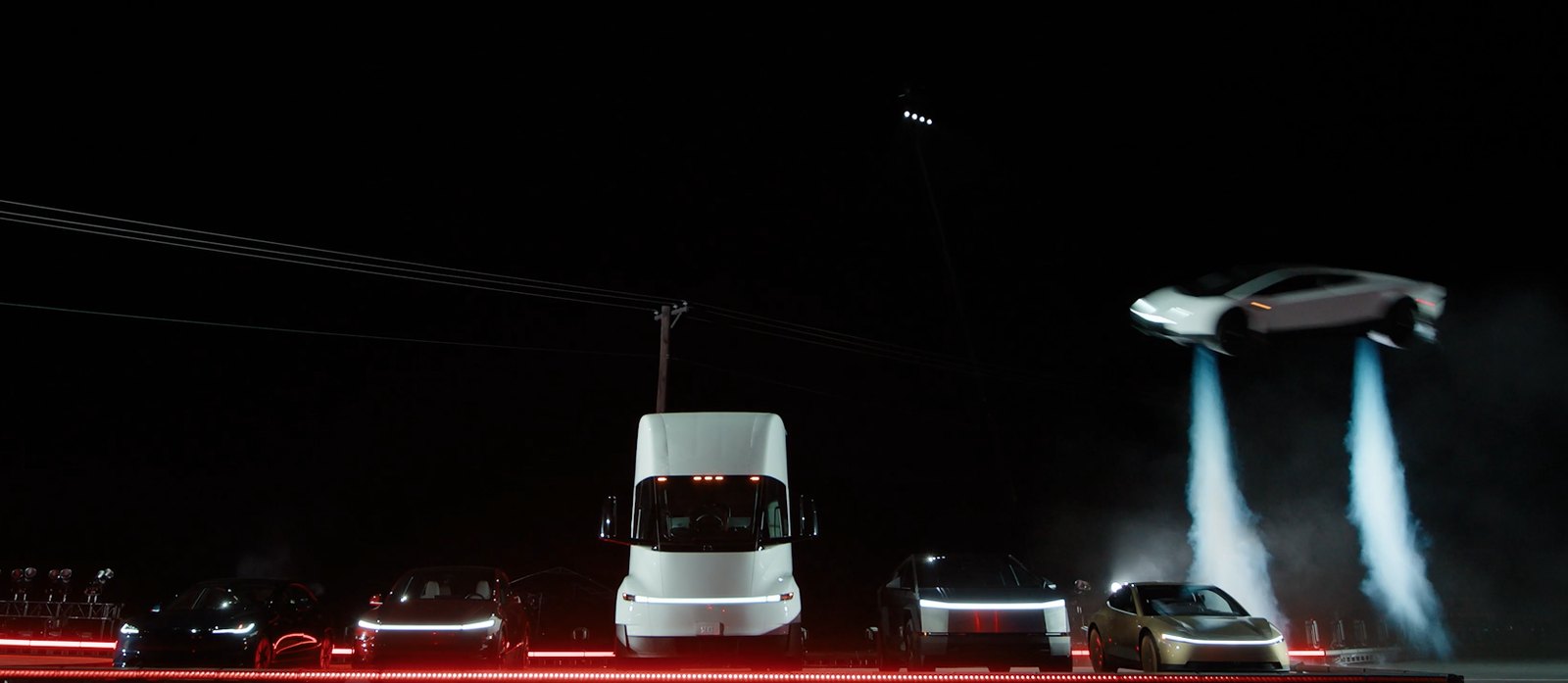
Every kid who grew up on Back to the Future was promised a flying car. Six days before the earnings call, Tesla unveiled its long-promised second-generation Roadster at a livestreamed event at SpaceX’s rocket-test site in McGregor, Texas — and the car flew. Using ten SpaceX-derived cold-gas thrusters fed by two pressurized tanks, it drove up and around a vertical arch, then jumped a line of five vehicles including a semi-truck, flipped end-over-end in mid-air, and landed on its wheels — a 68-foot leap that took about three seconds.
Tesla says the thruster system produces four to five times the force the tires can, which is how the company demonstrated 0–60 mph in under one second. Musk’s line from the stage: “Turns out the future does have flying cars.” Production is slated for 2028; reservations opened at $50,000 for the Performance version and $250,000 for the thruster-equipped “Thrust” version.
Watch it yourself, from Tesla’s own feed: the arch climb and landing → and the jump over the semi →
From the Publisher’s Desk
Why does a stunt belong in an investment letter? Because it is the clearest picture yet of what a merger would actually combine. The thrusters are SpaceX engineering in a Tesla body; the control software that flipped and landed the car is the same autonomy stack that runs the robotaxi. Two companies, one engineering culture, and a founder who just demonstrated on live video that the overlap he keeps describing is real hardware, not a slide.
Those of us who have been around a while were taught in school that the things NASA invented to get to the Moon ended up in our everyday lives — memory foam, cordless power tools, the camera sensor in your phone. Musk just closed that loop in one afternoon: rocket thrusters, in a car, at a rocket test site. Fifty years ago the technology went from space to the garage. Now it goes both ways.
Regular readers know our history here. In October 2013, with Tesla around $170, this letter called it “a $250 stock” before Wall Street would put its name to that number; split-adjusted, that call is now worth the equivalent of roughly $6,000 in 2013 shares. We are not making a new Tesla call today — the car business is still thin-margin and capital-hungry, and the merger math has not been written. But the two companies our readers already know best are now on a path to becoming one, and both of them are executing. If you own SPCX, you now have a reason to understand Tesla. If you own Tesla, you now have a reason to understand SPCX.
— Dave Jones
Bottom line
The July alert was the right call at the right price, and the quarter just reported is the reason. We are not chasing. We are holding what we have, adding on the dips, and watching December 8 and Starship Flight 15.
If you read our newsletter, you know we explain that we occasionally recommend companies in which we take an investment-banking consulting interest — always on a fully disclosed basis. The most-requested topic in our inbox is a request to deliver a mining company with explosive potential.
With gold above $4,000 and silver above $60, we are actively working on that full time — and the capital relationships we work with are asking for the same thing — and hope to have something for you soon.
If you have a referral, or you are involved with a gold or silver mining company, we would love to hear from you: dave@bmncapitalgroup.com.
Stay tuned.
— Dave Jones, Publisher, Wall Street Profit Search