Anthropic, the company behind the Claude AI models, has set its IPO price range at $70 to $78 a share and is expected to begin trading on the Nasdaq next week under the ticker ANT. It will be the second-largest IPO in history, behind only SpaceX in June.
Many of you have written to ask what we think. Here is the deal, the numbers, the risks, and our approach.
Price range
$70–$78
Filed Nov 10
First trade
Nov 19
Reported, not official
Valuation
~$1.4T
Top of range, diluted
For individuals
Up to 20%
Usual IPO: 5% to 10%
The deal in plain English
Anthropic and a few existing holders are selling 825 million shares. At the top of the range that raises $64.35 billion. SpaceX raised $85.7 billion in June.
Seven of the biggest names in technology are buying another $26 billion alongside you, at the same price. Nvidia and Google are in for $10 billion each, AMD for $2.5 billion, Broadcom, Micron and Microsoft for $1 billion each, and Taiwan Semiconductor for $500 million. These are the companies that sell Anthropic its chips and its computing power. They are paying the IPO price for stock that carries no vote.
The valuation is roughly $970 billion on the shares that will actually be outstanding, and $1.3 to $1.45 trillion if you count every option and convertible note. Anthropic was valued at $965 billion in its last private round in May. A month ago the bankers were talking about $2 trillion. The price came down. We will come back to why that is good news.
You can ask for shares at the IPO price. Anthropic says up to 20% of the offering may go to individual investors through Charles Schwab, Fidelity, Robinhood, SoFi and E*TRADE. Each firm has its own rules, and a request is not a guarantee. If you want shares, put your request in with your broker now.
You will not get a say in how the company is run. The seven co-founders keep 50.1% of the vote through a single special share, and an independent trust elects a majority of the board. You are buying a share of the business, not a voice in it.
We have not seen growth like this in a company of this size
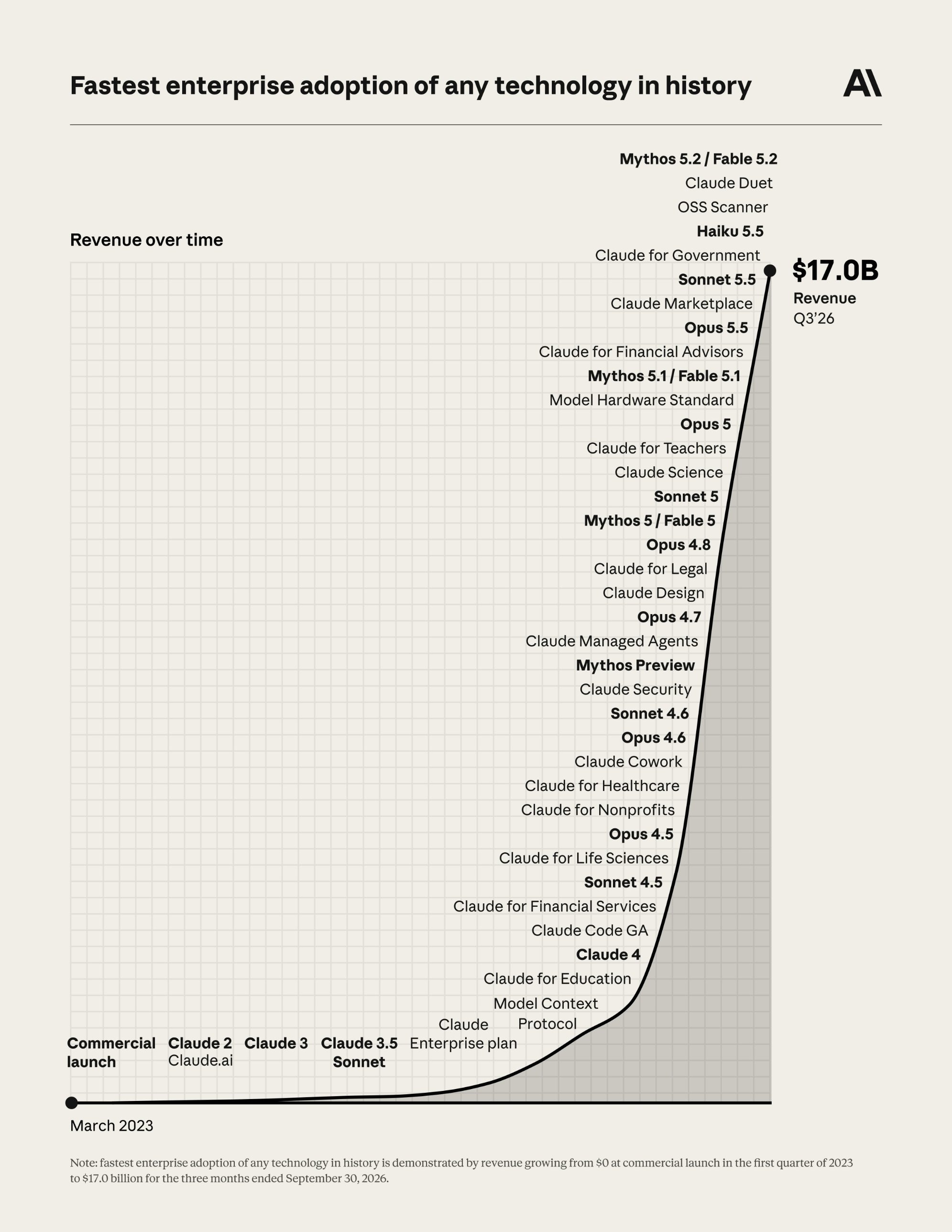
- Revenue was $386 million in 2024 and $4.6 billion in 2025.
- In the first nine months of 2026 it was $33.2 billion, with $17.0 billion of that in the third quarter alone.
- In October the business was running at an annual rate of $81 billion, up $10 billion in a single month.
- More than 1,900 customers now spend over $1 million a year, and about 250 spend over $10 million.
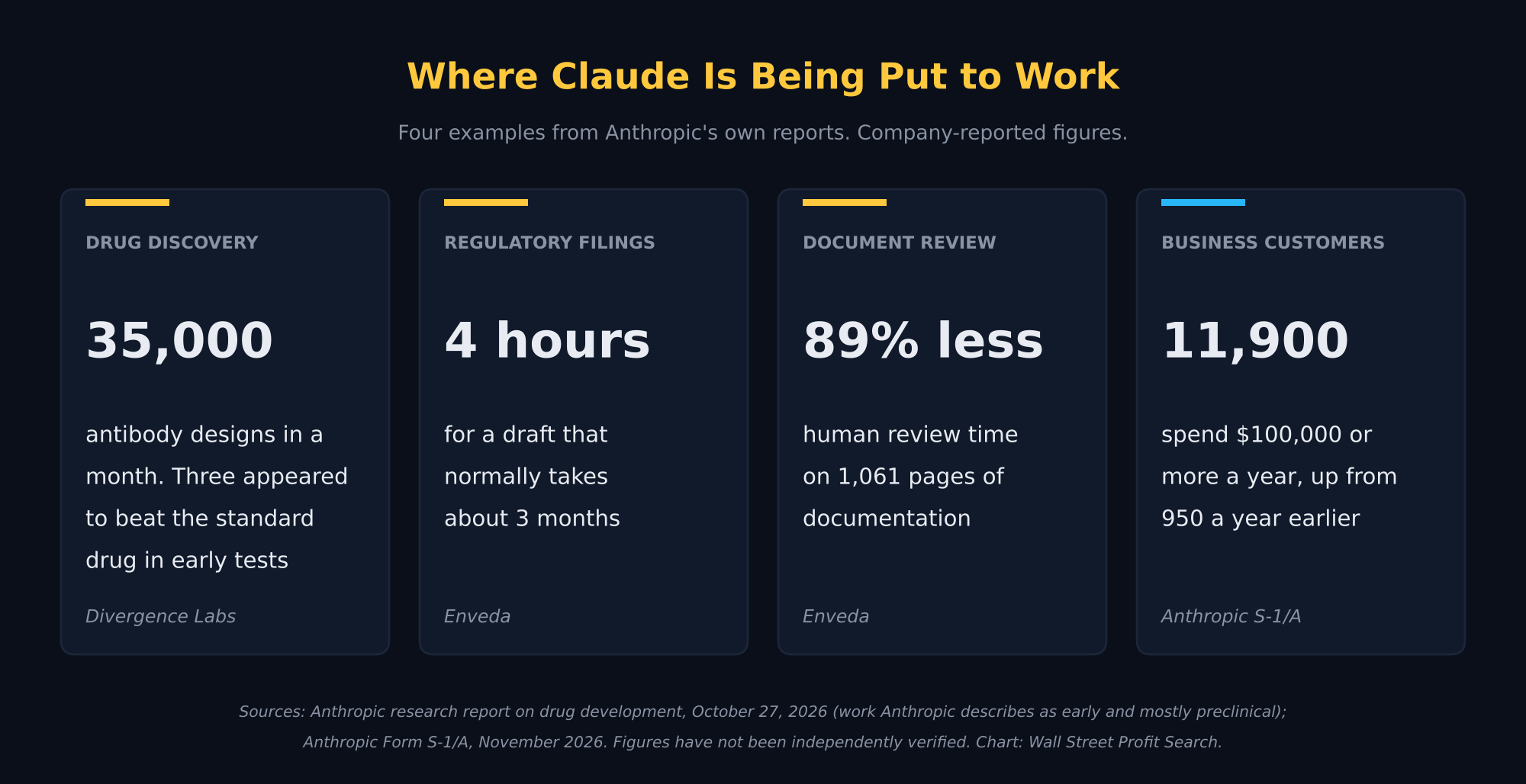
- A year ago 950 customers spent $100,000 or more. Today 11,900 do.
- About four dollars in five come from customers who pay by usage. The more work they hand to Claude, the more they pay. In the second quarter the company reported its first operating profit, $974 million.
This is not only about writing code.
Anthropic says it has been working with six drug developers, including Bristol Myers Squibb. At one of them, a regulatory filing that normally takes about three months was drafted in four hours. Finding a lead antibody the conventional way typically takes six months or more. Another partner had 35,000 computer-generated designs to test within a month, and three appeared to beat the standard drug in early tests. Anthropic itself calls this work early, and no medicine has reached patients because of it yet. But it shows where the spending is coming from.
What worries us
We would not be doing our job if we stopped there.
- The profit did not hold. The third quarter swung back to an operating loss of $567 million as the cost of computing power jumped to $9.9 billion from $5.6 billion the quarter before. Leave out stock-based pay and one-time items and the company earned about $2.5 billion, but the margin slipped.
- The paper loss is enormous. The filing shows a net loss of $23.3 billion in the third quarter alone. Of that, $21.9 billion is a non-cash accounting charge that grows as the company's own valuation rises, and no cash went out the door for it. Expect headlines about it anyway.
- The bills are already signed. Anthropic has committed to $895 billion of future spending, almost all of it on chips and data centers. If demand slows, those bills still come due.
- The price is full. At about $1.3 trillion you are paying roughly 16 times this year's annualized revenue.
- Washington has turned. AI stocks have sold off since the midterm elections on fears of tighter regulation and limits on data centers. In the same filing that set the price, Anthropic disclosed that it has crossed one of its own internal safety thresholds, because AI is now speeding up its own research. That means more safeguards, not a shutdown, but it will be in the news.
- More stock is coming. About 15.5 billion shares held by existing shareholders are locked up. Most come free within 180 days, some sooner, and the founders and largest holders within a year. The $26 billion placement is not covered by the underwriters' lock-up at all, although those shares cannot be freely resold for about six months.
Remember SpaceX. It came public at $135 in June. By late July it had been knocked down to about $111, below its own IPO price, and we put out an urgent buy alert. It bottomed at $108 in early August as the first insider shares came free. By October 6 it had hit a high of $176.42. Readers who bought in pieces and kept some cash back were paid for their patience.
We expect Anthropic to follow a similar script: a loud first day, a thin supply of shares, and then a stretch that will test the price. It will not only be the unlock dates; politics and public perception will weigh on this stock too, because there will keep being news that makes people uneasy about AI.
SpaceX, by the way, sells computing capacity to Anthropic. If you own SPCX, as many of you do, you already own a piece of this story.
Why a lower price is good news
Between the IPO and the private placement, investors are being asked to find about $90 billion for this one company, five months after they found $86 billion for SpaceX.
That money has to come from somewhere. Much of it comes from selling other stocks. At the same time inflation is running hot and the Federal Reserve is expected to raise rates again, which pulls money away from expensive stocks across the board.
So prices settle, and some stocks go down. We think that is healthy.
When prices come down, every dollar you invest buys more of the business. Anyone who is still building a position should want that. A market that only worries about keeping lofty valuations in place is a market that has stopped working.
From the Publisher’s Desk
A 29-year-old software engineer in Ohio told The Wall Street Journal that he lost his job at a bank seven months ago and has sent out 500 résumés. He wants tougher rules on AI data centers and better job protections. I do not blame him. I am 65, and there are days I long for simpler times too. But we have heard this request before, many times:
- In 1589 an English clergyman named William Lee built a machine that knitted stockings. The story goes that Queen Elizabeth refused him a patent because of what it would do to her hand-knitters. For centuries the craft guilds of Europe did the same thing. They decided who could work, how, and with what tools.
The places where the guilds lost their grip first, England and the Dutch Republic, are where the modern economy began.
- Closer to home, the Bell System once employed more than 300,000 telephone operators, and for decades you could not legally plug another company's device into its lines.
Today my phone calls anywhere in the world on WhatsApp for free. We would not have got there with the moat around Ma Bell still in place.
- The ATM was supposed to finish the bank teller. For thirty years it did the opposite. Branches became cheaper to run, banks opened more of them, and teller jobs held steady or grew. The decline began around 2010, when the smartphone let us deposit a check from the kitchen table. There are about 350,000 tellers today, down from roughly 600,000 at the peak, and the ones who remain do far more than count cash.
Fewer tellers, yes. But banking has never been easier to reach, for all of us. Imagine what it would cost if every one of those transactions still needed a person behind a counter.
- For forty years we have bought software that takes teams of coders and consultants to install and run, and that most of us could never learn to use properly. That inefficiency paid a lot of salaries. It also held the rest of us back.
AI is the next level above software. It lets an ordinary person use the tools that already exist without fifty consultants standing between him and the answer. That is why Anthropic's customers are spending what they are spending.
None of this was (or is) painless. Real people lose real jobs, and some never get back to where they were. A decent country helps them retrain. I am doing it myself right now, with AI as my teacher and coworker.
A job only lasts if the work creates real value, and no economy survives by freezing itself in place.
Sensible safety rules are one thing, and Anthropic itself asks for them. Rules written to keep yesterday's jobs exactly as they were or pretend things don't have consequences are a losing proposition:
- Europe decided it did not want to drill, frack, or keep its nuclear plants running, but it did not stop using energy. It bought it from Russia instead, and by Brussels' own count has sent Moscow more than $200 billion since the invasion of Ukraine. In effect, Europeans helped pay for a war on their own continent.
- The same goes for data centers. Say no to data centers here and the computing does not go away. It gets built somewhere we do not control. If the neighbors' worry is the electric bill or environmental impact, make the data centers pay for their own power and keep things as green as they can be. Or put them in orbit, which Elon Musk is already working on.
Protecting yesterday's jobs, blocking tomorrow's data centers, and propping up today's stock prices are the same instinct. It is the wish to keep things as they are.
Six hundred years ago China had the largest fleet on earth and chose to stop sailing. Europe took the oceans. China is not going to make that mistake twice, and the rest of the world is not going to stop building AI because we do.
— Dave Jones
Our recommendation
BUY THE IPO IF YOU CAN GET IT, THEN ACCUMULATE OVER TIME.
- If your broker can get you shares at the IPO price, take them.
- If you are buying in the open market, keep the first-day purchase small. Opening day is when the crowd pays the most. Build the position over months, and keep cash back for the price swings that unlock dates, politics and public perception will bring.
- This will be a volatile, headline-driven stock. As we said about SpaceX, that volatility is the friend of the patient buyer.
On the calendar
- Friday, November 13. CEO Dario Amodei is due to discuss the offering on a livestream with JPMorgan's Jamie Dimon.
- Wednesday, November 18. Reported pricing date.
- Thursday, November 19. Reported first day of trading on the Nasdaq under ANT.
- Early 2027. First earnings report as a public company.
- By about mid-May 2027. Most insider shares come free, at 180 days or after first-quarter results, whichever is first.
- By about November 2027. The founders and the largest holders come free.
The pricing and trading dates come from press reports and are not in the filing. IPO dates move. We will update you when the stock trades.
View our full Anthropic coverage: the S-1 filing and the latest articles →